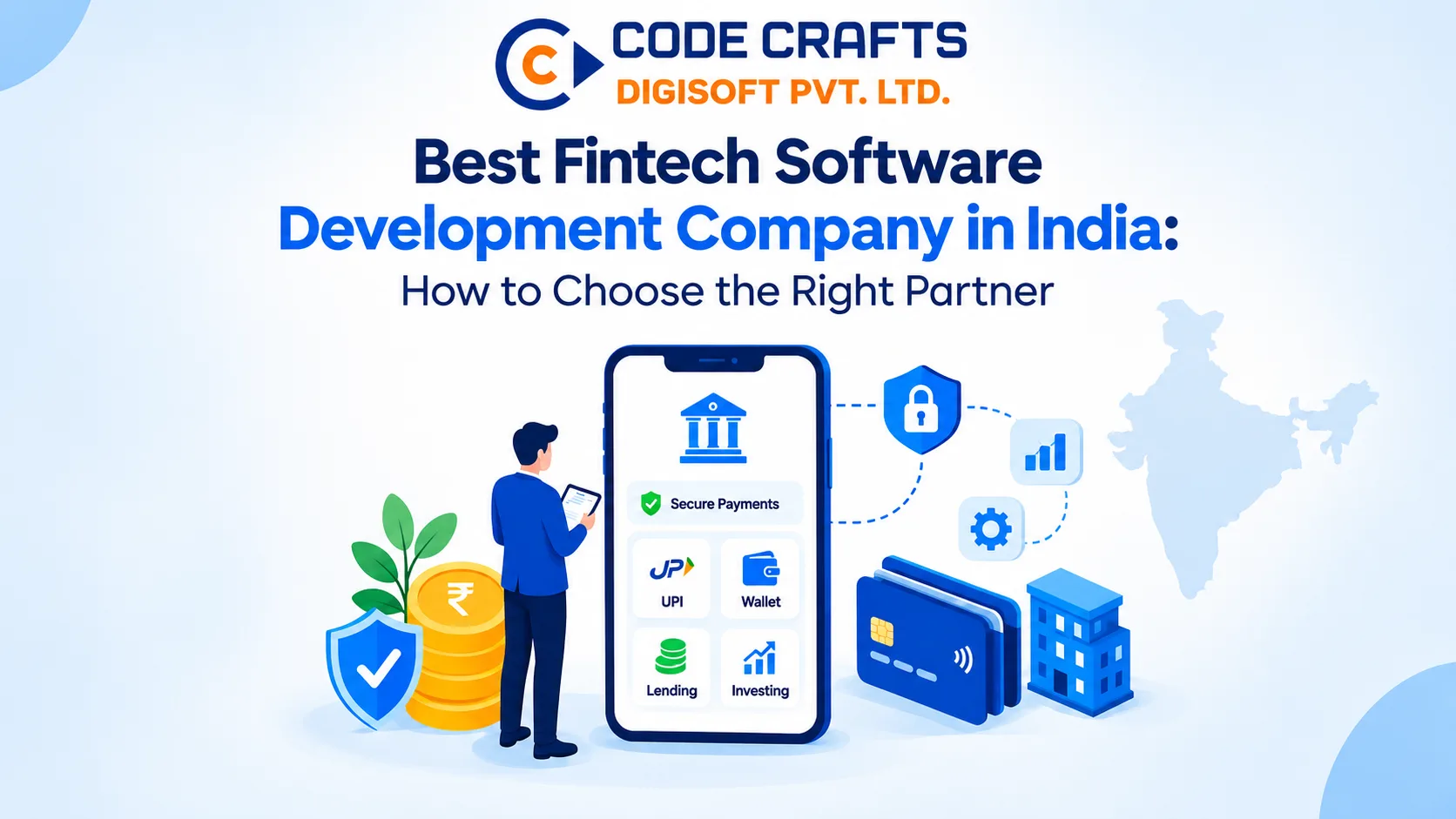
The selection of the right fintech software development company in India will be critical for startups, banks, retailers, financial services providers, and companies wishing to create a digital financial product. Be it payment platforms and digital wallets, or AEPS, DMT, or any other fintech software solutions, a proper technology provider will be able to make a business idea a reality.
Nevertheless, relying solely on the information provided in a “Top 10” list or a ranking article will not be enough. An impressive company website does not mean that a particular firm possesses the necessary expertise, security standards, and technical abilities to handle a specific project.
Fintech software solutions are different from regular business software solutions. They include handling financial transactions, processing sensitive customer data, as well as integration with external services. An improperly designed system can cause transaction failures, reconciliation issues, security vulnerabilities, and operational challenges.
In this article, we are going to cover the basics of fintech software development, necessary services for businesses, evaluation criteria of a development partner, cost factors, and how to select a fintech software development company in 2026.
Code Crafts Digisoft is a Jaipur-based fintech and software development company offering fintech platforms, API integrations, software development and digital solutions. This guide explains the factors businesses should evaluate before choosing a development partner, including Code Crafts Digisoft.
What Is FinTech in Software Development?
In other terms, Fintech or Financial Technologies are those technologies used in provision of financial services. It is the development of software meant to facilitate financial transactions in software development. It may vary from a system used in the payment of money only to platforms that may have a number of panel interfaces.
The following explains some of the fields in FinTech Software Development:
| Area | What the Software Does | Example |
| Payment solutions | Enables digital payments and transaction processing | Payment applications and payment gateway integrations |
| Digital wallets | Supports digital balance management and payment workflows | Customer and retailer wallet platforms |
| Lending software | Helps manage loan applications and repayment workflows | Digital lending platforms |
| Digital banking | Supports digital access to financial services | AEPS, DMT and micro ATM platforms |
| Investment software | Supports investment-related information and workflows | Investment management applications |
| Insurance technology | Helps manage insurance-related digital services | Policy management platforms |
| KYC and verification | Supports customer identity verification workflows | Digital onboarding systems |
| Financial reporting | Tracks transactions, settlements and operational activity | Reconciliation dashboards and transaction reports |
Such a fintech software development company develops or customizes these software applications for business organizations. Its duties depend on the nature of the project but may include requirement analysis, UI/UX design, backend development, API integration, testing, deployment, and security upgrades among others.
What Makes Fintech Software Different from Regular Software?
The software being created for Fintech should be precise and reliable. An average software application might take care of the information, reservations, and queries of customers only. The software application created for finance needs to pay attention to transaction accuracy as well.
Here are the key points to keep in mind:
- Transaction precision: All transactions need to be correctly recorded, and their status updated.
- Safety: Sensitive data, authentication details, and transactions need to be handled with appropriate security.
- Transactions failure: The process to check pending transactions and failed ones, to refund the money if necessary is required.
- Access permissions: Administrators, distributors, retailers, and customers need to access only those features that concern their roles.
- Reliability of external integration: Integration with other APIs and banks services should have the proper way to handle failures.
- Knowledge of compliance problems: The program should enable to meet all regulations of this particular financial product.
- Scalability: Ability to operate successfully with an increasing amount of users and transactions.
The above-listed points explain why it is extremely important to choose a partner in development that understands the financial process and application development equally well.
Fintech Software Development Services Businesses May Need
Fintech software development covers several types of services. The right combination depends on the business model, target customers, transaction volume and available infrastructure.
| Service | What It Includes | Suitable For |
| Payment gateway integration | Connecting payment services to a website, application or platform | Online businesses and digital platforms |
| Digital wallet development | Wallet interfaces, balance management and transaction workflows | Businesses offering wallet-based services |
| AEPS software solutions | Software workflows for Aadhaar-enabled payment services | Eligible fintech retailers and distributors |
| DMT software solutions | Digital money transfer workflows | Money transfer service networks |
| Micro ATM solutions | Software supporting applicable card-based banking workflows | Retailer networks and financial service providers |
| Payout integration | Automated disbursement workflows | Businesses making payments to customers, partners or vendors |
| White-label fintech solutions | Customisable platforms that can be offered under a business's own brand | Businesses seeking a faster launch |
| Custom fintech software | Software designed around specific business requirements | Startups and established businesses with specialised needs |
| API development and integration | Connecting applications with authorised external services | Businesses building connected financial products |
| KYC integration | Integrating customer verification workflows | Platforms that require identity verification |
| Admin and retailer panels | User management, permissions, reporting and transaction monitoring | Multi-level fintech businesses |
| Maintenance and support | Monitoring, updates, troubleshooting and improvements | Businesses operating live fintech platforms |
Fintech Services Offered by Code Crafts Digisoft
Digisoft Code Crafts provides solutions in the form of fintech and software services to firms which need digital financial services and technology support.
Areas of services provided by this service are:
- AEPS, DMT and micro ATM solutions suitable for appropriate retailer and distributor business models
- Solutions of digital wallets for workflow with wallet based services
- Payment out solutions for suitable payment and payout requirements
- Portals for B2B, B2C and resellers for managing multiple user and business needs
- API integration for integration of services and functionalities of the platform
- Custom software development for suitable business needs
- Development of website and mobile application for digital presence of businesses
Before opting for any solution, businesses should be aware of the functionalities available, dependency on third party and approval process.
Fintech Software Development Company vs. Fintech Product Business
The terms fintech company and fintech software development company are often used interchangeably, but they can describe different business models.
| Point | Fintech Product Business | Fintech Software Development Company |
| Main responsibility | Operates a financial product or service | Builds, integrates or maintains software for clients |
| Primary focus | Delivering its own financial service | Developing technology according to client requirements |
| Typical work | Customer transactions and service operations | Applications, portals, APIs and software integrations |
| Revenue model | May earn fees, commissions, interest or subscriptions | May charge project fees, platform fees or support charges |
| Project involvement | Runs its own product | Works with a client to develop or customise a product |
| Selection criteria | Product reliability, service availability and applicable permissions | Technical capability, relevant experience, security and support |
When you want to build a payment gateway, wallet, merchant portal, or other types of finance-related apps, you have to decide whether you really need to use the current platform, a customized one, or build something from scratch.
It can be used if your project is associated with fintech platforms, supporting portals, integration of APIs, or software customization. It is worth checking the relevancy of the selected solution to your project specs.
Best Fintech App Development Company in India: What Should You Look For?
Finding the best fintech app development company in India is just the first step. Before selecting a vendor, assess its capacity to build a secure and stable application.
1. Relevant Fintech Experience
Inquire if the development team has any experience developing a similar product to yours. General business application development experience does not necessarily mean fintech experience.
Request a demo, a detailed project explanation or references that you can check on your own.
2. Security by Design
Security must be thought of during the design process and not just before the release of the product. Inquire about data protection, authentication, authorization, credential management, security testing and incident response.
Do not believe any blanket statements like "100% secure" without proof.
3. API and Payment Integration Experience
Most fintech applications use third party APIs and payment systems. Inquire about how the development team deals with authentication, API failures, timeouts, retries and updates to the third party services.
Provide examples of integration experiences and make sure that all required integrations are covered in the scope of work.
4. Management of Pending and Failed Transactions
A good platform should have a clear plan for managing pending and failed transactions. Inquire how the system will check the status of transactions, record the result of the transaction and manage eligible transaction reversals.
5. Compliance Awareness
There are differences in regulations depending on the product, business model, and services provided. Request the developers to highlight the technical requirements and when there is a need for independent legal and compliance advice.
The software vendor should not offer regulatory approval without any reasonable justification.
6. Performance and Scalability
The software should be tested under the expected transaction volumes and concurrent users. Find out what kind of performance testing will be done and how the platform can scale as your business expands.
7. Documentation and Ownership
It should be clear from the contract which party will own the source code, application data, design and project documentation. The document should also include information regarding access to repositories, hosting account, third-party services and credentials.
8. Post-Launch Support
Fintech products require post-launch support. Find out the support hours, response times, bug fixes policy, update fees and escalation procedure before committing to the contract.
Types of Fintech Software Development Providers
There are various development providers for varying needs of project requirements. It shouldn’t always be thought that the largest and most costly provider available is the right one to pick.
| Provider Type | May Be Suitable For | What to Evaluate |
| Large IT service providers | Complex enterprise projects with extensive requirements | Budget, delivery structure and project attention |
| Fintech-specialist development teams | Products requiring financial workflow knowledge | Relevant experience, integration capability and security practices |
| Product-plus-software providers | Businesses that want a ready platform with customisation options | Feature availability, customisation limits and support |
| Boutique development studios | Smaller projects and early-stage product development | Team capacity, continuity and long-term support |
| Independent developers | Clearly defined, limited technical tasks | Security processes, documentation and availability |
The services offered by Code Crafts Digisoft include those related to fintech software and solutions such as AEPS, DMT, Micro ATM, Digital wallet and Payouts, B2B, B2C and Resellers portals.
The company boasts that they have over five years of experience behind them and have completed over 52 projects. Organizations will need to consider this statement along with the supporting evidence available.
Why Online Ranking Lists Can Mislead Fintech Buyers
Online articles titled “Best Fintech Software Development Company in India” can help you discover potential vendors, but their rankings should not replace your own evaluation.
Here are some of the reasons why one should be careful.
Articles use different criteria. Some of them consider size of the company, some – provided services, others – reviews in the Internet. Thus, without the methodology behind the ranking, you may not understand what provider is suitable for your project.
Commercial interests may affect recommendations. Some articles are written by companies that provide their services or websites with commercial relations. It does not mean that information is incorrect, but it is a reason to analyze the data.
Top position does not mean technical fit. The provider may have good web presence, but have no experience with your particular product, integrations or transaction processes.
Your requirements are unique. Your budget, security, integrations, timelines, customizations and support needs are different from other businesses.
Marketing statements require proof. Information about projects number, security, clients’ satisfaction and speed of delivery should be proved.
The method is simple. You should use ranking articles to make a list of providers and then analyze each company with the same set of questions, written requirements and technical criteria.
Best Fintech Software Development Company in India: 8 Checks Before Hiring
Use this checklist to compare Code Crafts Digisoft against your project requirements and make an informed decision.
| No. | Check | Question to Ask | Potential Warning Sign |
| 1 | Relevant experience | Have you developed a similar product? Can you demonstrate relevant work? | No relevant examples or verifiable details |
| 2 | Regulatory awareness | What technical requirements apply, and where is specialist advice needed? | Dismissing all compliance questions |
| 3 | Security | How are data, credentials and transactions protected? | Vague answers without a clear process |
| 4 | Integrations | Which APIs and payment services can you integrate? | No explanation of integration dependencies |
| 5 | Failure handling | How are pending transactions and reconciliation managed? | No defined transaction-status process |
| 6 | Ownership | Who owns the code, data and documentation? | Unclear contractual terms |
| 7 | Pricing | Can you provide a written breakdown of deliverables and exclusions? | A single price without a scope |
| 8 | Support | What support hours, response times and maintenance services are included? | No written support commitments |
Ask every shortlisted vendor the same questions. Record the answers and compare them against your priorities instead of relying on brand recognition or promotional claims.
Compliance and Security Checklist for Fintech Software
Security and compliance issues must be considered for fintech projects. The specific criteria to be met will depend on the product, the parties involved, the money flow and the laws.
| Area | Why It Matters | What to Confirm |
| Regulatory requirements | Different financial products follow different rules | Which rules apply and who is responsible for confirming them |
| Customer verification | Some services require identity checks | How verification workflows and exceptions are handled |
| Payment data | Financial information needs appropriate protection | What data is collected, processed and stored |
| Access control | Users need different permissions | How roles, authentication and permissions are managed |
| Transaction records | Financial operations need traceability | Whether transaction logs and audit trails are available |
| Error handling | Failed integrations can interrupt operations | How errors are detected, recorded and resolved |
| Testing | Problems are easier to address before launch | Which functional, security and performance tests are included |
| Data retention | Customer data must be managed appropriately | How retention, access and deletion requirements are handled |
| Incident response | Technical incidents can affect service availability | How incidents are reported, investigated and escalated |
Technical controls may be put in place with the help of a development firm; however, the company should not rely on software development to make its products compliant. Seek out legal and regulatory guidance before going live with the product.
What Determines Fintech Software Development Cost?
There is not a set rate for fintech software development. Even two applications with nearly identical interfaces may need to undergo drastically different amounts of back-end development.
The following are some common variables that affect pricing.
| Factor | How It Affects Cost |
| Product type | A limited application may require less work than a complete financial platform |
| Features | Additional workflows, reports and user functions increase development effort |
| Customisation | A ready platform may require less initial development than a fully custom solution |
| Security requirements | Stronger controls, testing and monitoring add work |
| Integrations | Each external API or service may involve separate setup and testing |
| User panels | Admin, distributor, retailer and customer panels add development complexity |
| Performance requirements | High transaction volumes may require additional architecture and testing |
| Documentation | Technical and operational documentation requires time |
| Deployment | Hosting, configuration, monitoring and production setup affect the total |
| Maintenance | Updates, monitoring, bug fixes and technical support may involve recurring costs |
How to Compare Development Quotes
Ask for a proposal that will separate development, integration, testing, deployment, and maintenance. Find out whether third-party API fees, hosting, licensing, taxes, and changes are included or billed separately.
The lower the cost of the initial quote, the higher the total cost of ownership during the lifetime of the product. This can happen due to the absence of security work, incomplete testing, or vague maintenance terms.
Code Crafts Digisoft can help you evaluate your needs and get a quote for your project according to your feature list and integration scope.
White-Label Fintech Solutions vs. Custom Software Development
Businesses planning to launch fintech services often need to decide between a white-label platform and custom development.
| Point | White-Label Solution | Custom Fintech Software |
| Starting point | Existing platform | Built around defined project requirements |
| Initial launch | May be faster if the required features are available | Usually requires more planning and development |
| Customisation | Depends on the platform's capabilities | Can be tailored to the agreed requirements |
| Initial cost | May be lower when the platform fits the use case | Depends on complexity and scope |
| Maintenance | Depends on the provider and contract | Depends on the delivery and maintenance agreement |
| Best suited for | Businesses seeking a quicker launch with standard features | Businesses needing specialised workflows or functionality |
If there is an existing service which has features which match your needs, a white-label solution could be an ideal solution for you to adopt. If you have very specific processes or require deeper integration with your product, customisation may work better for you.
However, before choosing either of these solutions, there are some questions that you should be asking about.
Does the Location of a Fintech Development Company Matter?
Fintech software development companies have operations in India, and most of the projects can be handled using online conferences. Having a local development firm will make the physical discussion process easy, but this is not an indicator of quality.
| Consideration | What to Evaluate |
| Cost | Compare the complete scope and long-term cost rather than location alone |
| Technical expertise | Look for relevant fintech and integration experience |
| Communication | Confirm meeting frequency, reporting and escalation processes |
| Project management | Understand milestones, testing and delivery responsibilities |
| Support | Check availability and written response-time commitments |
| Business understanding | Ensure the team understands your users and operational requirements |
Code Crafts Digisoft is located in Jaipur, Rajasthan, and can be an option for those firms that are seeking fintech and software development solutions. Indian firms need to analyze their proposal, the way they communicate, their technical expertise and support system before taking any decision.
Why Consider Code Crafts Digisoft for Fintech Software Development?
Code Crafts Digisoft is a Jaipur-based software development and fintech solutions provider firm catering to companies that require digital platform and software services.
The key fields of expertise at Code Crafts Digisoft include fintech solutions, software development, website development, mobile application development, and digital marketing.
Key Service Areas
AEPS, DMT and micro ATM solutions: Software for digital banking and retailer services workflows.
Digital wallets and payouts: Technology for wallet and disbursement transactions.
B2B, B2C and resellers portal: Platforms which can serve different business models and user roles, depending on the scope agreed for the selected service.
API integration: Integration of supported services and systems for the execution of the business workflow.
Custom software development: Software built around the business workflows.
Website and mobile application development: Digital products for businesses that require website and mobile application.
Technical support: Technical support according to the terms of the selected service.
What Should You Confirm Before Starting?
Before approaching Code Crafts Digisoft or any other developer for your project, you need to talk about:
- Your business model and target audience
- Features needed and the various user panels
- API and services that your application should interact with
- The security and compliance liabilities
- Timeline and milestones of the project
- Ownership of the source code, data and intellectual property
- Testing and deployment
- Support level and charges
This way both parties can understand the scope of the project better.
To discuss your requirements, visit the Code Crafts Digisoft website. You can request information about available services and the solution best suited to your project.
Conclusion
Selecting the best software development company for fintech in India is not just a case of seeing their rankings in the Internet. It is essential for a business to look into experience of vendors in particular niche, their data protection procedures, ability to integrate the product, deal with failed transactions, terms of ownership, pricing and after launch support services.
First of all, you have to establish the requirements and choose if it makes sense for you to go with a white label, customized or totally customized product. Then, you have to analyze the vendors using one single check list. Request a proposal in writing from vendors under comparison.
As an example you can consider Code Crafts Digisoft for your requirements of fintech platforms, AEPS, DMT, micro ATM, digital wallet, payout services, API integrations, resellers portals or customization.
Frequently Asked Questions
About Author

Codecrafts Digisoft
Expert content creator and technology enthusiast at Code crafts Digisoft Pvt. Ltd.