India’s fintech ecosystem is growing rapidly, creating opportunities for businesses to offer digital payments, banking support services, bill payments, money transfers, and financial solutions through a single platform. However, building a reliable fintech platform requires more than developing an attractive dashboard or mobile app. It involves API integration, regulatory compliance, transaction security, reconciliation, user management, and scalable software architecture.
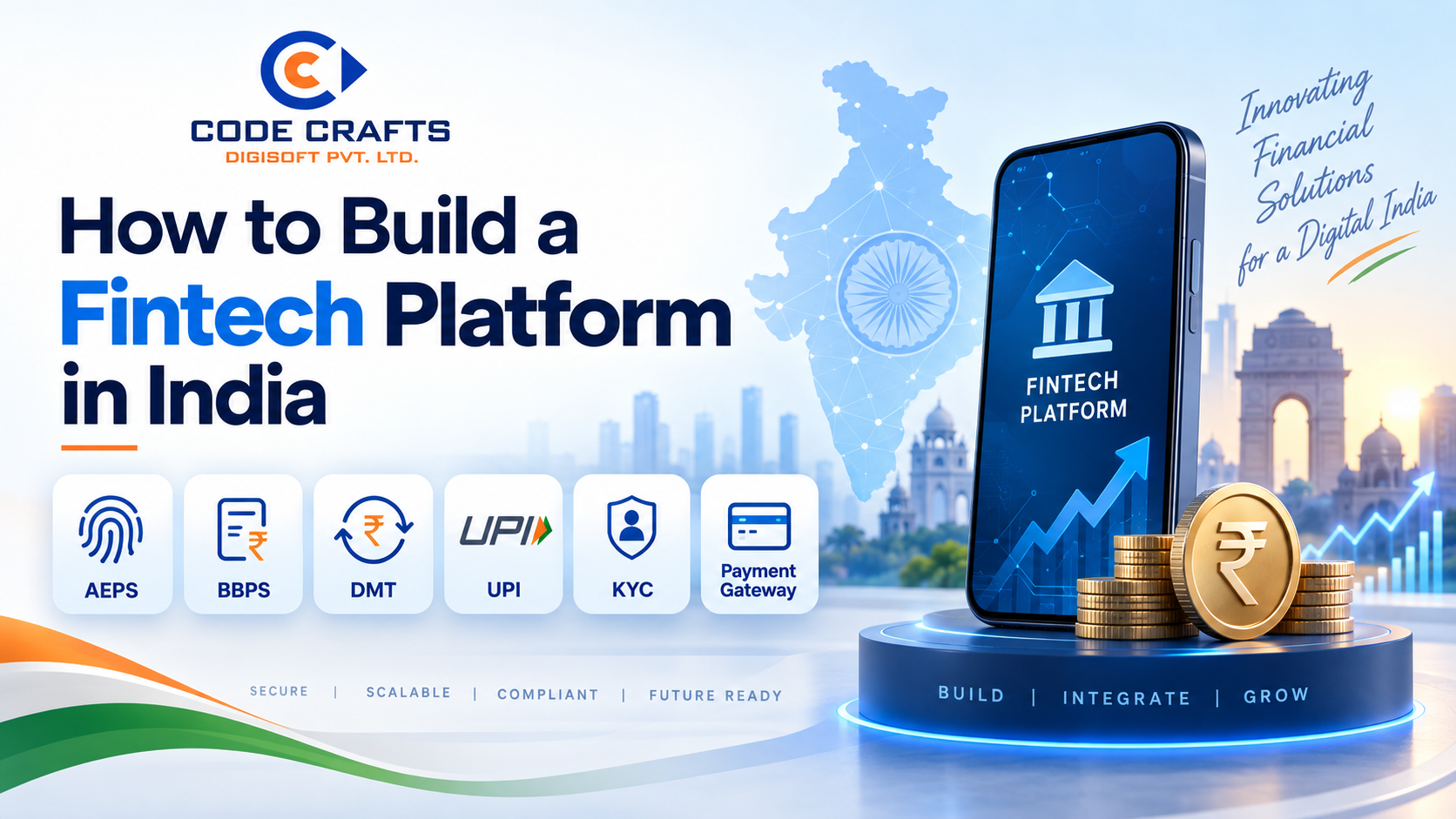
A fintech platform may include services such as Aadhaar Enabled Payment System (AEPS), Bharat Bill Payment System (BBPS), Domestic Money Transfer (DMT), Unified Payments Interface (UPI), KYC verification, and payment gateway integration. Each service has different technical requirements, transaction flows, compliance considerations, and operational challenges.
Code Crafts Digisoft Pvt. Ltd. helps businesses develop custom software solutions for startups, SMEs, and enterprises. Based in Jaipur, Rajasthan, the company focuses on building secure, scalable, and business-oriented web and mobile platforms designed around specific operational requirements.
What Is a B2B Fintech Platform?
A B2B fintech platform enables businesses, agents, retailers, distributors, or corporate users to access financial services through a software system. Unlike a simple consumer payment application, a B2B fintech platform usually includes role-based access, commission management, transaction monitoring, wallet services, reporting, API integrations, and administrative controls.
For example, a fintech company may provide a retailer portal where agents can:
- Perform AEPS transactions.
- Transfer money to bank accounts.
- Pay utility bills.
- Process UPI or payment gateway transactions.
- Complete customer KYC verification.
- View commissions and transaction history.
- Raise complaints or service requests.
The platform provider connects these services through authorised banking, payment, KYC, and bill-payment partners. The business can then provide financial services to its network without building every banking infrastructure component from the ground up.
A typical B2B fintech system contains:
- Admin panel.
- Distributor and retailer dashboards.
- Customer-facing website or mobile application.
- Wallet and ledger management.
- Commission and surcharge configuration.
- Transaction processing engine.
- API gateway.
- KYC and compliance module.
- Notifications and reporting system.
- Reconciliation and settlement module.
This model helps fintech businesses expand their service portfolio and manage multiple partners from one central system.
What APIs Are Needed?
The APIs required depend on the services your platform plans to offer. A complete fintech platform generally uses several categories of APIs.
AEPS APIs
AEPS APIs allow customers to perform basic banking services using Aadhaar authentication and biometric devices. Common services include:
- Cash withdrawal.
- Balance enquiry.
- Mini statement.
- Aadhaar-to-Aadhaar fund transfer.
- Aadhaar Pay, where supported.
AEPS APIs usually require retailer onboarding, device validation, transaction authentication, bank selection, Aadhaar-related inputs, and a secure response-handling system.
BBPS APIs
BBPS integration enables users and agents to pay utility bills through a central platform. Common bill categories include:
- Electricity.
- Water.
- Gas.
- Mobile postpaid.
- Broadband.
- DTH.
- Insurance.
- Loan repayments.
- FASTag and other recurring payments.
The platform generally uses APIs to fetch billers, validate customer details, retrieve outstanding bills, initiate payments, and check transaction status.
DMT APIs
Domestic Money Transfer APIs allow users or agents to send money to bank accounts. These APIs commonly support:
- Beneficiary registration.
- Beneficiary verification.
- Bank account validation.
- Fund transfer.
- Transaction status enquiry.
- Beneficiary deletion or modification.
DMT workflows must handle transaction limits, beneficiary cooling periods, OTP validation, failed transfers, refunds, and settlement reporting.
UPI APIs
UPI integration may support collect requests, intent-based payments, QR payments, virtual payment addresses, transaction status checks, and refunds. The exact implementation depends on the acquiring bank, payment service provider, or authorised UPI partner.
UPI-related functionality should include:
- Payment initiation.
- QR code generation.
- Payment confirmation.
- Webhook handling.
- Transaction status verification.
- Refund processing.
- Duplicate transaction prevention.
KYC and Verification APIs
KYC APIs help verify customer, retailer, distributor, or business information. Depending on the use case, a platform may need:
- PAN verification.
- Aadhaar-based verification through authorised providers.
- Bank account verification.
- GST verification.
- Business registration checks.
- Mobile and email verification.
- Document upload and validation.
- Video KYC or identity verification services.
KYC requirements should be designed with the guidance of compliance professionals and relevant regulated partners.
Payment Gateway APIs
Payment gateway APIs help businesses accept online payments through cards, net banking, UPI, wallets, and other supported methods. Key functions include:
- Order creation.
- Payment initiation.
- Checkout processing.
- Callback or webhook verification.
- Refunds.
- Settlement reports.
- Payment status checks.
A strong API layer should standardise responses from different service providers. This prevents the frontend from depending directly on the unique format of every external API.
How Does AEPS Integration Work?
AEPS integration connects your fintech platform with an authorised AEPS service provider or banking partner. The process usually follows several stages.
1. Retailer onboarding
The retailer or agent registers on the platform. The system collects required business, contact, banking, and KYC information. After verification, the retailer receives access to the AEPS module.
2. Device registration
AEPS transactions generally require a certified biometric device or an approved authentication mechanism. The device may need to be registered with the service provider and mapped to the retailer account.
3. Customer authentication
The customer provides the required Aadhaar-linked banking information and biometric authentication. The application securely sends the transaction request to the AEPS provider.
4. Transaction processing
The AEPS provider communicates with the relevant banking network and processes the request. The transaction may be approved, rejected, delayed, or placed in a pending state.
5. Response and ledger update
The platform receives the response and updates the retailer’s dashboard, customer receipt, wallet ledger, and transaction history. The system must also handle cases where the response is delayed or interrupted.
6. Reconciliation
The platform compares internal transaction records with the service provider’s settlement report. This helps identify pending, failed, reversed, or mismatched transactions.
AEPS integration must not rely only on the immediate API response. A transaction-status mechanism, retry policy, webhook support, and reconciliation process are essential for preventing incorrect wallet deductions and customer disputes.
What Security Measures Are Required?
Fintech platforms handle sensitive financial and identity data, so security should be included from the planning stage rather than added after development.
Important security measures include:
- HTTPS and TLS encryption for data in transit.
- Encryption of sensitive information at rest.
- Secure API authentication using tokens, signatures, or certificates.
- Role-based access control.
- Multi-factor authentication for administrators and high-risk users.
- Device and session management.
- Rate limiting and request throttling.
- Input validation and protection against injection attacks.
- Secure webhook verification.
- Audit logs for administrative and financial actions.
- Fraud detection and transaction risk monitoring.
- IP and device monitoring for suspicious activity.
- Strong password policies.
- Automated backups and disaster recovery.
- Secure secret and key management.
- Regular vulnerability assessments and penetration testing.
Sensitive data should not be stored unnecessarily. Access to customer information must be restricted according to user roles and business requirements. The platform should also maintain clear records of who accessed, changed, approved, or reversed a transaction.
Compliance requirements may differ depending on the service, business model, technology partner, and role of the organisation. Businesses should work with authorised providers and obtain legal and compliance advice before launching financial services.
Recommended Fintech Architecture
A scalable fintech platform can be organised into several layers.
Presentation layer
This includes the web portal, admin panel, agent dashboard, distributor dashboard, and mobile applications. The interface should be simple because many users may access the system from mobile devices or low-bandwidth environments.
Application layer
This layer contains business rules for commissions, transaction limits, wallet deductions, user permissions, KYC status, refunds, and service availability.
API gateway layer
The API gateway manages requests between the platform and external providers. It can handle authentication, logging, rate limiting, response standardisation, and routing.
Integration layer
This layer connects AEPS, BBPS, DMT, UPI, KYC, payment gateway, SMS, email, and notification providers. Keeping integrations separate makes it easier to replace or add service partners later.
Data and ledger layer
The ledger should record every credit, debit, commission, surcharge, refund, and adjustment. Financial records should be immutable or protected through controlled reversal entries rather than being deleted.
Monitoring and reconciliation layer
This layer checks transaction status, detects mismatches, tracks settlements, and generates operational reports. It is one of the most important components in a fintech system.
What Is the Fintech Development Process?
The development process should be structured around business operations, compliance, and transaction reliability.
1. Business and service analysis
The development team first identifies the target users, service categories, transaction volumes, partner requirements, commission structure, and operational workflow.
2. Technical and compliance planning
The business selects appropriate API providers, hosting architecture, authentication methods, KYC processes, reporting requirements, and security controls.
3. UI and user experience design
Separate experiences are planned for administrators, distributors, retailers, agents, and customers. Each user should see only the features relevant to their role.
4. Backend and API development
Developers build the user management system, wallet, ledger, commission engine, transaction modules, API gateway, reporting system, and notification workflows.
5. Third-party integration
AEPS, BBPS, DMT, UPI, KYC, payment gateway, SMS, email, and other APIs are connected in a controlled test environment.
6. Testing
Testing should cover successful transactions, failed transactions, pending responses, duplicate requests, timeout scenarios, refunds, reversals, concurrency, security, and role permissions.
7. Pilot launch
A limited group of retailers or business users can test the platform before the full launch. Their feedback helps identify workflow and usability problems.
8. Deployment and support
After production deployment, the platform needs monitoring, issue resolution, partner coordination, security updates, API maintenance, and ongoing improvements.
Code Crafts Digisoft Pvt. Ltd. follows a structured approach covering consultation, planning, development, launch, and support. This process helps businesses convert their fintech concept into a practical digital product.
What Problems Occur During API Integration?
API integration is often one of the most challenging parts of fintech development. Common problems include:
- Inconsistent response formats between providers.
- Incomplete or unclear API documentation.
- Different authentication requirements.
- Sandbox and production environments behaving differently.
- Delayed transaction responses.
- Duplicate callbacks or webhooks.
- Missing webhooks during network interruptions.
- Rate limits and service downtime.
- Provider-specific transaction status codes.
- Failed transactions without immediate final confirmation.
- Incorrect wallet deductions.
- Settlement and ledger mismatches.
- Changes to API versions or partner policies.
- Difficulties testing real banking scenarios.
These issues can be reduced through an integration layer that standardises responses and uses idempotency keys to prevent duplicate processing. The platform should also include queues, retries, timeout handling, callback verification, transaction-status polling, alerting, and manual reconciliation tools.
A practical example is a DMT request that times out after the user clicks “Send Money.” The system should not automatically deduct the wallet again. Instead, it should mark the transaction as pending, verify its status with the provider, and update the ledger only after receiving a reliable result.
How Should Businesses Choose a Fintech Development Company?
Businesses should evaluate a fintech development company on more than design quality or development cost.
Consider the following factors:
- Experience with AEPS, BBPS, DMT, UPI, KYC, and payment gateway projects.
- Understanding of wallet, ledger, commission, and settlement workflows.
- Ability to work with third-party API providers.
- Knowledge of secure authentication and webhook handling.
- Experience developing admin, distributor, retailer, and customer portals.
- Clear communication and documented project milestones.
- Strong testing and quality-assurance processes.
- Post-launch technical support.
- Scalable architecture and maintainable code.
- Transparent ownership of source code and documentation.
- Realistic timelines and clearly defined deliverables.
Ask potential development partners how they handle failed transactions, pending statuses, refunds, reconciliation, API downtime, and security testing. These questions reveal whether the company understands real fintech operations or is focused only on building the visible interface.
Code Crafts Digisoft Pvt. Ltd. is a Jaipur-based full-cycle software development company that works with startups, SMEs, and enterprises. The company provides custom web and mobile development services and focuses on creating secure, scalable, and future-ready software solutions. Its development process includes consultation, planning, development, launch, and ongoing support.
Benefits of Building a Custom Fintech Platform
A custom fintech platform can provide several business benefits:
- Centralised management of multiple financial services.
- Greater control over commissions and user roles.
- Improved visibility into transactions and settlements.
- Better customer and retailer experience.
- Flexible integration with new service providers.
- Automated reports and reconciliation.
- Support for business-specific workflows.
- Scalable infrastructure for future growth.
- Stronger brand identity than a generic solution.
- Easier expansion into new regions and service categories.
The right platform architecture can help a business manage complexity while keeping the experience simple for agents and customers. However, fintech development should always prioritise security, compliance, transaction accuracy, and operational support.
Final Thoughts
Building a fintech platform in India requires careful planning across technology, integrations, user experience, security, compliance, and business operations. AEPS, BBPS, DMT, UPI, KYC, and payment gateway services each have different workflows, so they should be connected through a well-designed API and transaction architecture.
A reliable platform should include secure authentication, role-based access, wallet and ledger controls, reconciliation, transaction-status management, monitoring, and scalable infrastructure. By partnering with an experienced fintech development company such as Code Crafts Digisoft Pvt. Ltd., businesses can create a custom platform aligned with their service model, user requirements, and long-term growth plans.
Frequently Asked Questions
About Author

Codecrafts Digisoft
Expert content creator and technology enthusiast at Code crafts Digisoft Pvt. Ltd.