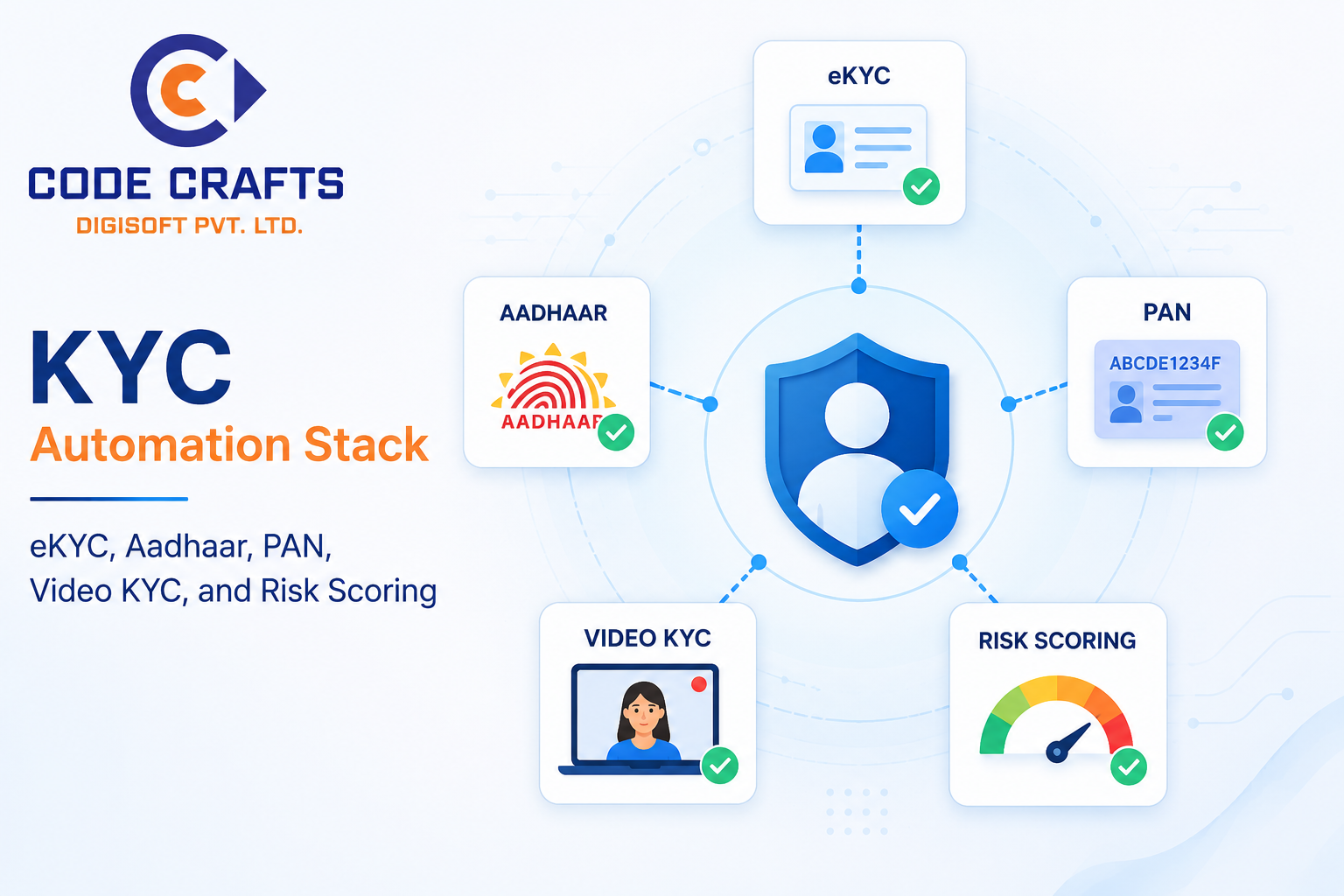
In India’s rapidly evolving fintech and banking landscape, a robust KYC (Know Your Customer) automation stack is no longer optional—it’s a strategic imperative. For businesses ranging from NBFCs and digital lenders to payment wallets and co-operative banks, automating identity verification across eKYC, Aadhaar, PAN, Video KYC, and risk scoring delivers faster onboarding, stronger compliance, and lower fraud losses.
At Code Crafts Digisoft Pvt. Ltd., we design and deploy end-to-end KYC automation solutions tailored to Indian regulatory requirements and real-world operational needs. Our stack integrates seamlessly with your existing systems to create a frictionless, secure, and audit-ready customer onboarding experience.
Why KYC Automation Matters in 2026
Regulatory expectations have tightened significantly. The Income Tax Department now mandates real-time Aadhaar authentication for new PAN applications, and the December 31, 2025 deadline for PAN–Aadhaar linking means inoperative PANs from January 1, 2026 for non-compliant users. Simultaneously, RBI’s Video-based Customer Identification Process (V-CIP) remains mandatory for full KYC on high-value products, pushing institutions toward hybrid digital workflows.
Manual KYC processes struggle under this pressure. They’re slow, error-prone, and expensive. Automation addresses these pain points head-on:
- Cuts onboarding time from days to minutes, improving conversion and customer satisfaction.
- Reduces operational costs by minimizing manual review, rework, and physical document handling.
- Ensures ongoing compliance with RBI, UIDAI, and Income Tax Department guidelines through auditable digital trails.
- Strengthens fraud prevention via AI-driven deduplication across face, Aadhaar, PAN, and demographic data.
Components of a Modern KYC Automation Stack
A production-grade KYC stack layers multiple verification methods to balance speed, security, and regulatory coverage. Here’s how each component fits:
1. eKYC (Electronic KYC)
eKYC enables instant, paperless verification using Aadhaar-based OTP or biometric authentication. It’s ideal for low-risk, high-volume onboarding scenarios such as wallet activations or small-ticket loans.
Key capabilities:
- Real-time identity validation against UIDAI records
- Automated demographic data capture (name, DOB, address)
- Consent-managed, audit-ready logs for compliance
Business impact: Organizations using eKYC report significantly faster approval cycles and reduced drop-off rates during onboarding.
2. Aadhaar Verification
Aadhaar serves as the foundational identity layer in India’s KYC ecosystem. Modern stacks support both OTP-based and offline XML verification, with mandatory real-time authentication for new PAN applications since July 2025.
Integration benefits:
- Eliminates manual document collection and data entry errors.
- Enables seamless PAN–Aadhaar linking checks, now critical for NBFC compliance.
- Supports geotagged, time-stamped verification sessions for audit readiness.
3. PAN Verification
PAN validation confirms identity against the Income Tax Department’s database via NSDL/Protean APIs. It’s essential for credit products, high-value transactions, and tax-compliant onboarding.
What automated PAN checks deliver:
- Instant confirmation of PAN status (active/inoperative)
- Name matching and de-linking alerts
- PAN–Aadhaar linking status verification, mandatory under current RBI
With the 2026 rule changes making Aadhaar-only PAN routes more common, automated PAN verification helps prevent “shadow identities” and duplicate cards.
4. Video KYC (V-CIP)
Video KYC satisfies full KYC requirements under RBI rules through a live, recorded interaction between a trained agent and the customer. It’s mandatory for products like credit cards and loans above ₹60,000 for certain NBFCs.
Operational advantages:
- Cost efficiency: One agent handles more verifications per day, lowering cost per customer.
- Geographic reach: Verify customers anywhere in India with internet access, without physical branches.
- Audit trail: Every session is recorded, timestamped, and stored for concurrent audit.
- Fraud reduction: AI-assisted liveness detection and face-to-document matching reduce impersonation risks.
Asynchronous AI-assisted V-CIP further reduces agent dependency and session costs while maintaining compliance.
5. Risk Scoring
Risk scoring evaluates the customer’s profile using verified KYC data, behavioral signals, and external credit inputs. It powers dynamic decisioning—approving low-risk users instantly while flagging high-risk cases for enhanced due diligence (EDD).
How it works in practice:
- Aggregates data from Aadhaar, PAN, device fingerprinting, and transaction history
- Applies rule engines and ML models to generate risk scores
- Triggers automated workflows: instant approval, manual review, or rejection
Integrated credit evaluation tools help lenders assess loan eligibility and reduce default risk with confidence.
How Code Crafts Digisoft Powers Your KYC Transformation
Code Crafts Digisoft Pvt. Ltd. specializes in building custom fintech software that embeds KYC automation into your core operations. Our solutions are designed for Indian regulatory complexity and scaled for real-world performance.
Our KYC Automation Benefits
- End-to-end integration: We connect eKYC, Aadhaar, PAN, Video KYC, and risk scoring into a unified workflow, eliminating silos.
- Regulatory alignment: Built-in compliance with RBI V-CIP, UIDAI Aadhaar guidelines, and Income Tax PAN rules.
- Cost reduction: Clients see up to 40% lower operational costs through automation and efficient workflows.
- Fraud mitigation: AI-driven deduplication and liveness checks strengthen identity assurance.
- Scalable architecture: Handles high-volume onboarding spikes without performance degradation.
- Audit readiness: Every verification step is logged, timestamped, and retrievable for inspections.
Real-World Use Cases
- Digital lenders: Automated loan origination with instant KYC and ML-based credit scoring.
- Payment wallets: Frictionless eKYC for rapid user activation and compliance.
- Co-operative banks: Instant eKYC via Aadhaar/PAN with integrated credit evaluation for member loans.
- NBFCs: Hybrid workflows combining Video KYC for high-value products and eKYC for low-risk segments.
Building Your KYC Stack: Key Considerations
When designing or upgrading your KYC automation, focus on these pillars:
- Regulatory compliance first: Ensure every module aligns with current RBI, UIDAI, and Income Tax requirements.
- Modular flexibility: Choose components you can scale independently—start with eKYC, add Video KYC as product complexity grows.
- Data security: Implement encryption, consent management, and access controls to protect sensitive identity data.
- Vendor integration: Work with partners who offer pre-built APIs for Aadhaar, PAN, and V-CIP to accelerate deployment.
- Continuous monitoring: Use risk scoring and anomaly detection to adapt to emerging fraud patterns.
The Bottom Line
KYC automation is the backbone of modern digital onboarding in India. By integrating eKYC, Aadhaar, PAN, Video KYC, and risk scoring into a cohesive stack, businesses can achieve faster conversions, lower costs, and bulletproof compliance.
Code Crafts Digisoft Pvt. Ltd. delivers precisely this—custom-built, regulation-ready KYC automation that scales with your growth. Whether you’re launching a new lending product, upgrading your wallet onboarding, or modernizing your co-operative bank’s operations, our stack ensures you stay ahead of both customers and regulators.
Ready to transform your KYC workflow? Explore how Code Crafts Digisoft can power your next-generation onboarding engine.
Frequently Asked Questions
About Author

Codecrafts Digisoft
Expert content creator and technology enthusiast at Code crafts Digisoft Pvt. Ltd.