Launching a fintech product is not only about developing software. It is about making the right decision between speed, flexibility, security, compliance, scalability, and long-term ownership. For startups, financial institutions, NBFCs, payment businesses, lending companies, and digital service providers, one of the first major decisions is whether to choose a ready-made fintech platform or invest in custom fintech software development.
At Code Crafts Digisoft Pvt. Ltd., we help businesses evaluate their digital requirements and build secure, scalable, and business-focused software solutions. As a full-cycle software development company, our approach is to align the platform with the company’s operational model, users, growth plans, and risk requirements—not simply select the quickest available option.
Both ready-made and custom fintech platforms have their place. A ready-made product can help businesses enter the market quickly, while a custom solution gives organizations deeper control over features, workflows, integrations, and customer experience. The best choice depends on what your business needs today and where you want it to go tomorrow.
What Is a Ready-Made Fintech Platform?
A ready-made fintech platform is a pre-built software solution designed for common financial services use cases. It may include modules for customer onboarding, digital wallets, payment processing, lending, KYC, transaction monitoring, reporting, merchant management, and admin controls.
These platforms are often sold as SaaS products, white-label solutions, or subscription-based software. Businesses can configure branding, enable selected features, and launch faster than they would with a completely new product.
For example, a payment reseller may use a ready-made platform to offer merchant onboarding, QR payments, payment links, transaction tracking, and settlement reports under its own brand. Similarly, a lending business may deploy a pre-configured loan application system with basic borrower registration, document upload, EMI tracking, and dashboard access.
The major attraction is speed. Instead of designing every workflow from the ground up, businesses can use an existing framework and focus on branding, operations, marketing, and customer acquisition.
However, ready-made does not always mean risk-free. It can reduce development time, but it may introduce limitations related to feature ownership, data control, third-party dependency, customization, and future expansion.
What Is a Custom Fintech Platform?
A custom fintech platform is built specifically around a business’s requirements. Its features, workflows, interface, permissions, integrations, data architecture, and security controls are planned according to the company’s actual operating model.
For instance, a custom fintech solution could include:
- A multi-level b2b portal for distributors, agents, merchants, and administrators
- A dedicated reseller application for partners to onboard customers and manage transactions
- Role-based dashboards for finance teams, compliance officers, support executives, and channel partners
- Custom payment, banking, identity-verification, accounting, or CRM integrations
- Automated workflows for lending approval, settlement, reconciliation, commission calculation, and dispute management
- Branded mobile applications for Android and iOS users
- Reporting systems designed around the company’s own KPIs and regulatory needs
A custom solution takes more planning and development time, but it gives the business greater control over its platform. Rather than adjusting internal processes to fit a generic product, the software is designed to support the business’s preferred workflow.
This approach is particularly valuable for fintech companies that expect high transaction volumes, operate through resellers or agents, need specialized compliance processes, or plan to introduce multiple financial products over time.
Time to Market: The Main Advantage of Ready-Made Platforms
The strongest reason businesses choose ready-made fintech software is faster market entry. A pre-built product may allow a company to launch in weeks rather than months, depending on the amount of configuration and integration required.
This can be useful when a company wants to test an idea, launch a pilot program, validate customer demand, or quickly establish an online presence. A startup with limited capital may not need every advanced feature at the beginning. It may only need a functional platform that lets customers register, complete transactions, access support, and view basic reports.
Ready-made solutions can also work well for businesses entering a standardized market. If the core functionality is already established and customers do not require a highly differentiated experience, a configurable solution may be enough.
For example, a company entering the reseller hosting market may initially need standard account creation, billing, package management, customer support, and reporting. In this stage, a pre-built system can reduce the waiting time involved in developing every feature from scratch.
But fast launch should not be confused with long-term readiness. A platform that works for 100 users may not work smoothly for 100,000 users. A dashboard that serves one internal team may become difficult to manage when multiple resellers, merchants, support teams, and compliance staff begin using it.
The key question is not only, “How quickly can we launch?” It is also, “Can this platform support us after the launch?”
Custom Development Takes Longer—but Reduces Strategic Constraints
Custom fintech software requires a discovery phase, requirement analysis, UI/UX planning, architecture design, development, testing, security assessment, deployment, and post-launch support. Naturally, this takes longer than adopting a ready-made product.
However, the additional time can be a strategic investment.
A custom platform allows a business to build the exact systems it needs from day one or in planned phases. Instead of paying for unnecessary features or adapting to fixed workflows, the business can prioritize the modules that create the most value.
For example, a fintech company working with channel partners may need a sophisticated reseller application that manages onboarding, wallet balances, commissions, service access, support tickets, and real-time reports. A ready-made platform may provide a basic partner dashboard, but a custom solution can reflect the company’s commission model, approval hierarchy, service categories, and settlement structure.
Custom development also makes it easier to add new products without rebuilding the entire system. If a company begins with payment services and later adds lending, insurance, prepaid cards, merchant financing, or investment-related features, a flexible architecture can make expansion more manageable.
At Code Crafts Digisoft Pvt. Ltd., the goal is to create software that supports both immediate operational needs and future digital transformation. A clear consultation, planning, development, launch, and support process helps businesses build technology around their growth objectives.
Understanding the Risk Difference
Time is important, but risk is often the more critical factor in fintech. Financial platforms manage highly sensitive data, transactions, customer identities, payment records, account balances, and business-critical workflows. A weak decision at the platform stage can create operational, security, legal, and reputational challenges later.
Risks of ready-made fintech platforms
Ready-made software can create dependency on a third-party vendor. If the vendor changes its pricing, limits an API, discontinues a feature, delays updates, or has downtime, your business may have limited control.
Other common risks include:
- Limited ability to customize workflows for unique business processes
- Difficulty integrating with specific banking, payment, KYC, CRM, or accounting systems
- Restricted access to source code or platform architecture
- Shared infrastructure concerns in some SaaS environments
- Challenges in changing vendors or migrating data
- Generic reporting that does not match business or compliance requirements
- Feature limitations as transaction volume and user roles increase
These risks do not mean ready-made software is always a poor choice. They simply mean the vendor evaluation process must be thorough. Businesses should understand who owns the data, how data can be exported, what happens if the subscription ends, how security updates are managed, and whether the platform can support future integrations.
Risks of custom fintech development
Custom development has different risks. The biggest concern is selecting an inexperienced development partner or beginning the project without clear requirements. Poor planning can lead to missed deadlines, growing costs, unnecessary features, and avoidable security gaps.
To reduce these risks, businesses should ensure that their development process includes:
- Detailed requirement gathering before coding begins
- Clear scope definition and phased delivery planning
- Secure architecture and role-based access management
- Testing for performance, usability, integrations, and transaction workflows
- Proper documentation and source-code ownership terms
- Ongoing maintenance, monitoring, and support
- A scalable infrastructure plan from the beginning
Custom development can be more expensive upfront, but it helps reduce the risk of outgrowing a generic platform. It also gives businesses greater control over their intellectual property, customer experience, data structure, and future roadmap.
Comparing Ready-Made and Custom Fintech Platforms
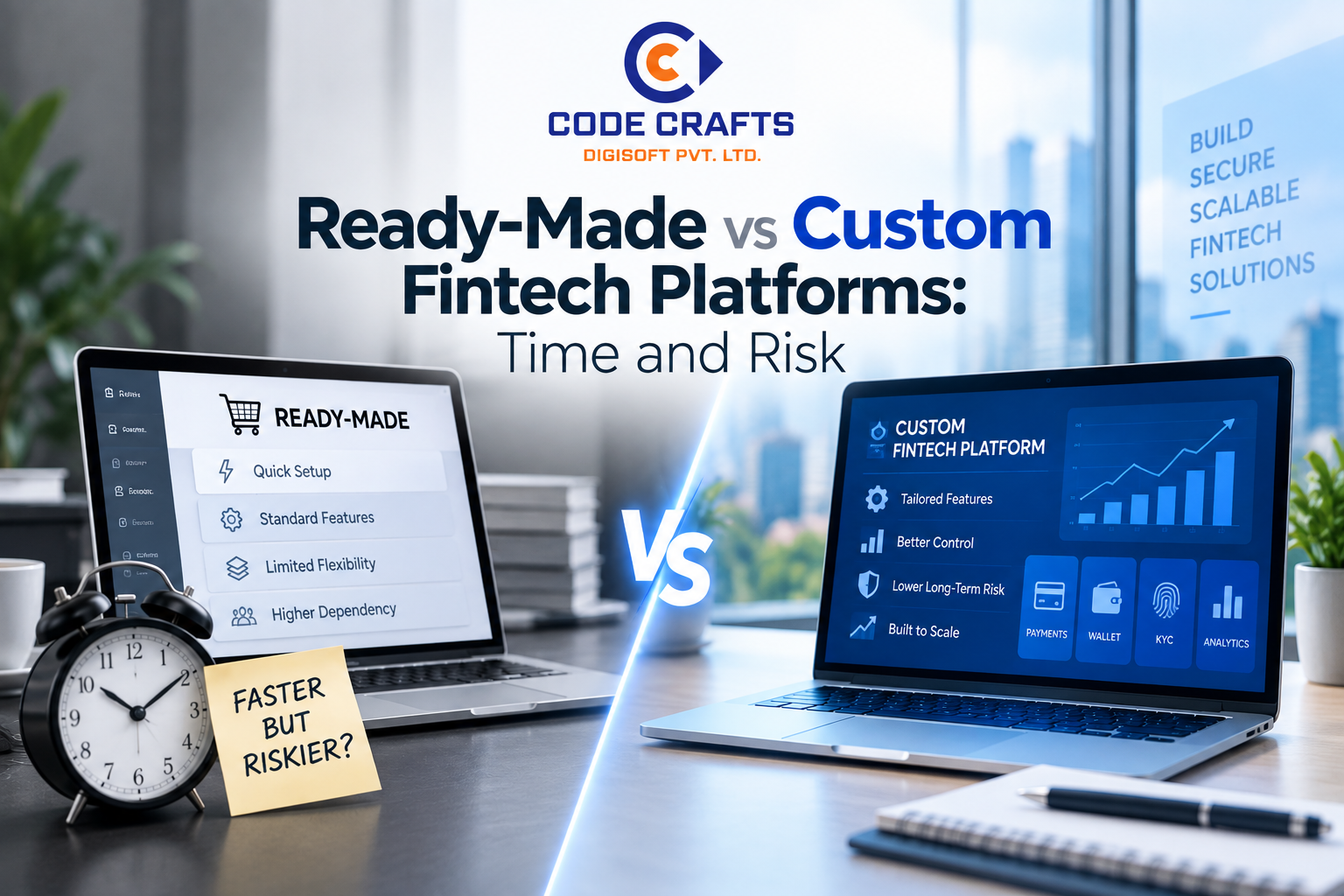
| Factor | Ready-Made Platform | Custom Fintech Platform |
| Launch time | Faster; suitable for quick pilots and standard use cases | Longer; requires planning, design, development, and testing |
| Initial investment | Usually lower upfront | Higher upfront due to tailored development |
| Customization | Limited to available settings and modules | Built around specific business workflows |
| Scalability | Depends on the vendor’s infrastructure and product limits | Can be designed for planned user, transaction, and product growth |
| Security control | Shared with or controlled by the vendor | Greater control over architecture and security measures |
| Integration flexibility | Limited by existing APIs and vendor support | Can integrate with required third-party systems |
| Ownership | Often subscription-based with vendor dependency | Greater control over source code, product roadmap, and data |
| Competitive differentiation | May look similar to other businesses using the same solution | Supports a unique user experience and operating model |
| Long-term adaptability | Can become restrictive as needs evolve | Easier to expand in phases with the right architecture |
When a Ready-Made Platform Makes Sense
A ready-made fintech solution may be suitable when:
- You need to launch a minimum viable product quickly.
- Your business model is simple and follows common industry workflows.
- You have a limited initial budget.
- You want to validate market demand before making a larger investment.
- You do not require highly specialized integrations.
- Your early-stage priority is customer acquisition rather than technical differentiation.
- You need a standard reseller, merchant, payment, or service dashboard with limited customization.
For example, if a business wants to test a reseller model for digital services, it may start with a ready-made portal and basic reseller hosting services. This can help the company understand user adoption, support requirements, and demand patterns before investing in advanced automation or a fully customized b2b portal.
The business should still plan for data portability, security, vendor support, and future migration. A quick launch is valuable only when it does not create a difficult transition later.
When Custom Fintech Development Is the Better Choice
Custom development is usually the stronger option when technology is central to your business value. If your platform itself is the product, not merely a supporting tool, customization becomes more important.
Choose a custom fintech platform when:
- Your workflows are unique or complex.
- You operate with multiple user roles, partners, agents, or resellers.
- You need a specialized reseller application.
- You require advanced dashboards, reporting, commissions, settlement, or reconciliation.
- You plan to connect multiple APIs, banking systems, payment gateways, or compliance tools.
- You need control over customer data and software ownership.
- You expect significant transaction volume or rapid scaling.
- You want to create a distinctive and branded customer experience.
- You plan to add new financial products and services in the future.
A custom platform is especially useful for organizations that want to build a long-term digital asset. Instead of repeatedly patching a generic system, businesses can build a solution that evolves with their strategy.
The Better Decision: Think Beyond Launch Day
The choice between ready-made and custom fintech software should not be based only on today’s budget or launch deadline. It should be based on your future business model.
A ready-made platform can be a practical starting point when the objective is speed, validation, and basic functionality. It can help businesses reduce initial development effort and enter the market faster.
A custom fintech platform is a more strategic investment when your organization needs flexibility, control, security, scalability, and differentiated workflows. It is particularly beneficial for companies building a strong reseller ecosystem, a multi-role b2b portal, financial dashboards, mobile apps, or integrated digital services.
The best route may also be phased development. A company can begin with essential custom modules, launch a focused version of the product, collect real user feedback, and then add advanced functionality in planned stages. This balances time-to-market with long-term platform control.
Build a Fintech Platform That Supports Growth
Fintech businesses need more than attractive screens and basic transaction features. They need secure technology, well-defined workflows, scalable architecture, reliable integrations, and an experience that builds trust with customers, partners, and internal teams.
Code Crafts Digisoft Pvt. Ltd. develops custom digital solutions for startups, SMEs, and enterprises, with an emphasis on secure, scalable, and future-ready software. Whether your requirement is a custom fintech platform, a reseller application, a b2b portal, a mobile app, or a digital system to manage complex financial workflows, the right development strategy can reduce operational risk while supporting sustainable growth.
Before selecting a ready-made platform or starting a custom project, assess your current requirements, expected users, transaction scale, compliance needs, required integrations, ownership expectations, and three-year growth roadmap. The platform you choose should not only help you launch—it should help you grow with confidence.
Frequently Asked Questions
About Author

Codecrafts Digisoft
Expert content creator and technology enthusiast at Code crafts Digisoft Pvt. Ltd.